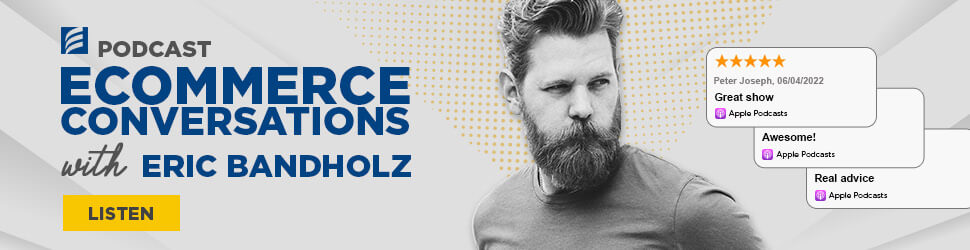


Cheryl Sew Hoy says her company deals with poop. The Austin, Texas-based serial entrepreneur launched Tiny Health in 2020 to help folks monitor essential microorganisms in their digestive systems, which are critical for overall wellness.
The process once required in-person doctor visits with cumbersome stool collection. Tiny Health offers the same service with a streamlined home-based kit and a prepaid mailer for the lab analysis.
In our recent conversation, Cheryl shared the importance of gut health and details of Tiny Health’s launch, customer acquisition tactics, funding rounds, and more. Our entire audio is embedded below. The transcript is edited for clarity and length.
Eric Bandholz: What do you do?
Cheryl Sew Hoy: I’m the founder and CEO of Tiny Health. Bluntly speaking, we deal with poop. Customers send us swabs of their poop. We analyze it in a lab and produce a report about what’s in the poop and the gut microbiome, the 38 trillion health-related microbes living inside humans.
To us, “gut” means the large intestine. Gut health is directly connected to our immune system. Eighty percent of the human immune system lives in the gut. It is crucial for overall well-being and is also tied to chronic conditions if you don’t take care of it.
Bandholz: Your service provides access to tests that once required a doctor’s visit. Is that it?
Sew Hoy: Yes and no. It depends on the stool analysis. Persistent diarrhea or constipation may require a doctor’s diagnosis and treatment, which might include antibiotics.
What we do with the stool analysis is different. We use a technology called shotgun metagenomic sequencing that detects all the bugs in your gut, including bacteria, parasites, viruses, archaea, and fungi.
The human gut has many beneficial bacteria. Conventional medical education and public discourse often miss this. The bacteria in our guts digest our food and nutrients, and produce metabolites and enzymes that support overall health.
For example, athletic teams and even pro athletes come to us to optimize performance and fitness because they travel a lot and are under stress from training and recovery.
Bandholz: Walk us through how you collect and analyze customers’ samples and produce reports.
Sew Hoy: We send customers a kit. It includes a small, prepaid USPS shipping box. Customers open the kit, which contains a swab. They collect their stool, swab it, drop the swab in a tube-like container, put it in the box, and mail it to us. It’s relatively easy.
We also offer a clinical-grade test that has a more involved collection method and two-day shipping. Only practitioners with certain licenses can order it.
We understand that folks don’t want to collect poop. We’ve innovated the process with a swab that resembles a Q-tip.
Bandholz: Tell us about the launch process.
Sew Hoy: I started the company in 2020 when my son was just a week old. I spent the first two years, before our public launch in 2022, understanding microbiome research and science.
I took PhD-level classes online to educate myself and understand our staffing needs, such as the right scientists and clinical staff. My advisory board included mentors from the Mayo Clinic, Johns Hopkins, and similar institutions.
I launched the company with $50,000 of my own money. I offered equity initially to team members because I didn’t have the cash to pay them.
My $50,000 funded a study with nine subjects. I wanted to prove I could build the platform with the help of scientists I retained.
After collecting the data for one year, I raised $4.5 million in seed money in 2021. I hired my first engineer and my first full-time scientist. I’m not a scientist, a microbiologist, or a doctor. We just closed a series B funding round for $33 million.
This is my second venture-funded company. I built my first, a digital wallet and daily deals company, in New York in 2010 and sold it to Walmart Labs in 2013.
Bandholz: How does Tiny Health acquire customers?
Sew Hoy: Advertising is our primary driver. Roughly 50% of new customers come from Meta Ads and Google Search. We’re getting started with TikTok and Pinterest.
The other half is organic, driven by content. We’re adapting to LLMs and genAI visibility, away from traditional SEO. Email marketing and Instagram influencers are huge for us, too. Plus, we have a B2B component where we work directly with healthcare practitioners.
We also go to trade shows and give talks at conferences.
Bandholz: Where do listeners buy your test or reach out?
Sew Hoy: We’re at TinyHealth.com. I’m on LinkedIn.




 New Ecommerce Tools: September 16, 2026
 New Ecommerce Tools: September 23, 2026
 Test Your Products for AI Discovery
 Branded Sites Are Vital for Merchants
 Shopify Opens to Meta Muse; Amazon Balks
 Does Retail Media Add Value?